
The 6 Best Lemlist Alternatives for LinkedIn Outreach in 2026
Lemlist is the most established tool in this comparison by a wide margin: over 2,000 G2 reviews, bootstrapped, and genuinely good at multichannel sequencing. Email is $69 per user per month, multichannel $109, both about 20% cheaper annually.
Almost everyone who looks for an alternative is hitting the same wall, and it is not the price. It is that one Lemlist seat connects to exactly one LinkedIn account.
Lemlist alternatives at a glance
| Tool | From | LinkedIn accounts | Primary channel | Runs |
|---|---|---|---|---|
| Waalaxy | ~€19/mo | 1 per user | LinkedIn + email (€69 tier) | Waalaxy cloud |
| Reachy AI | $59/mo | 15 on $299 flat | your machine | |
| Dripify | $59/mo | per user | cloud | |
| La Growth Machine | €60/identity/mo | 1 per identity | LinkedIn + email + X | cloud |
| HeyReach | $79/sender/mo | unlimited on flat plan | cloud | |
| Expandi | $99/mo | 1 per seat | LinkedIn + email | cloud |
| Lemlist | $69/seat/mo | 1 per seat | email + LinkedIn | cloud + extension |
Vendor-published as of August 2026.
Why look for a Lemlist alternative?
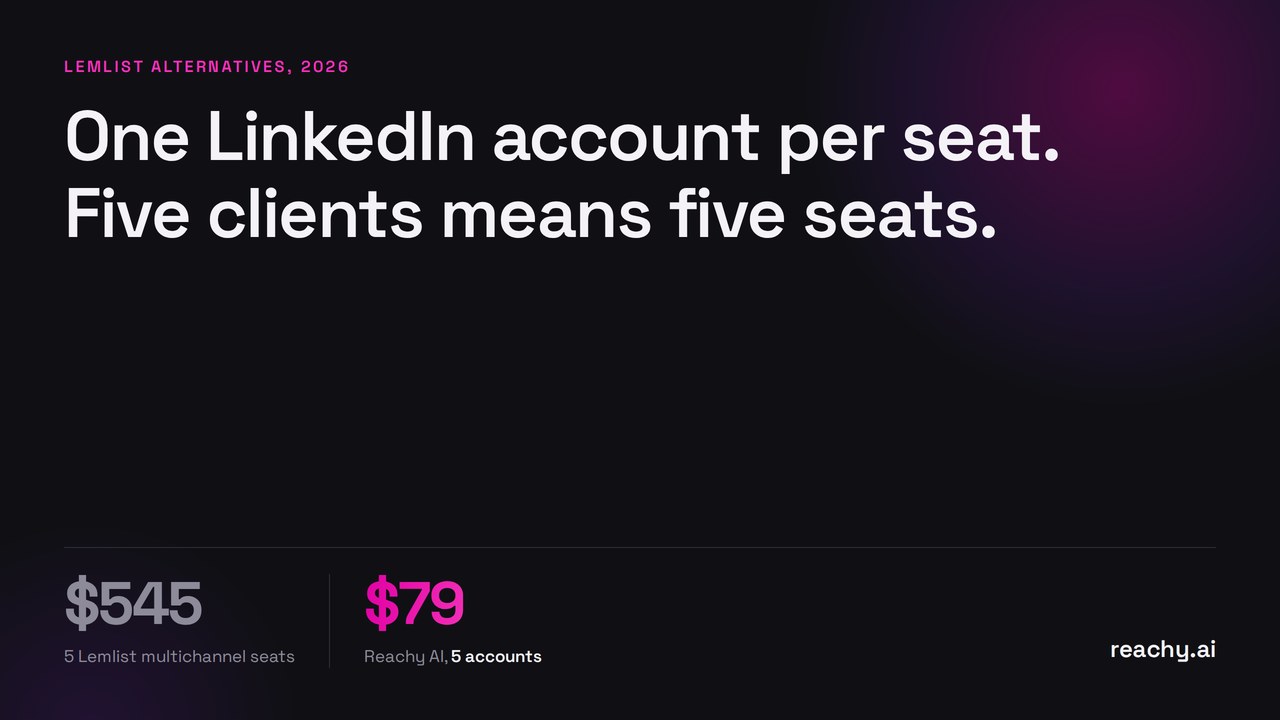
One LinkedIn account per seat. If you run outreach for five clients, that is five seats, each needing its own Chrome profile. At $109 multichannel that is $545 a month, and the seat count is driven by LinkedIn profiles rather than by how many humans work there.
Email-first design. Lemlist grew up as a cold email tool and it shows in the best way for email and the mildest way for LinkedIn. If LinkedIn is 80% of your pipeline, you are buying a tool optimised for the other 20%.
AI is bundled. lemAgent, enrichment, reply-intent detection and voice notes are all included, which is genuinely convenient. It also means the model cost sits inside your subscription with a margin you cannot inspect.
It is cloud plus an extension. LinkedIn actions run through a Chrome extension against a cloud backend, so you inherit both models: a browser that has to be open, and a service that holds your data.
Credit where due: 2,026 G2 reviews at 4.6 is more independent validation than every other tool in this article combined, and being bootstrapped means their pricing is not being set by a funding timeline.
1. Reachy AI, if LinkedIn is the channel that matters
Disclosure: I build Reachy AI.
Reachy AI is the inverse bet. One channel, done deeply, on your machine, with flat pricing that does not track seat count: $59 for one account, $149 for five, $299 for fifteen. Five client LinkedIn accounts is $149, against roughly $545 for five Lemlist multichannel seats.
The AI is the other structural difference. It is included on every plan, and you can connect your own OpenAI, Claude, Gemini or OpenRouter key and pay the provider directly at 0% markup, so writing and ICP scoring cost what the tokens cost.
Pick something else if email is doing real work in your pipeline. Reachy AI does not send email, and no amount of LinkedIn depth compensates if half your replies come from an inbox.
2. HeyReach, if you need many LinkedIn senders
$79 per sender, with a flat unlimited plan for larger operations, a unified inbox and per-client reporting. It solves the exact constraint that pushes people off Lemlist, at agency scale.
Pick it if you are past twenty senders. Below that, Reachy AI vs HeyReach does the math.
3. La Growth Machine, if you want more channels, not fewer
LinkedIn, email and X in one sequence, from €60 per identity. It is the natural sideways move if what you liked about Lemlist was breadth and what you disliked was the LinkedIn depth.
Watch out: identity pricing has the same shape as seat pricing. It does not solve the multi-account cost problem either.
4. Expandi, if you want LinkedIn-first cloud with email attached
$99 per seat, LinkedIn-native with an email layer, country-based dedicated IPs, long operating record. Roughly Lemlist multichannel money with the channel priorities reversed. Reachy AI vs Expandi.
5. Waalaxy, if you want to spend a fifth as much
LinkedIn from around €19 per user monthly, with email gated to the €69 tier. Much less product than Lemlist at a fraction of the price. Note that Waalaxy retired its Chrome extension in June 2026 and now runs fully in its own cloud, so it is not the local option some older comparisons still describe. Reachy AI vs Waalaxy.
6. Dripify, if you only kept the LinkedIn half
$59 monthly, $39 annually, LinkedIn sequences. The simplest answer if an honest audit says the email campaigns stopped running months ago. Reachy AI vs Dripify.
Which should you actually pick?
- You need more LinkedIn senders than seats: Reachy AI at $299 for fifteen, or HeyReach past twenty senders.
- Email is genuinely half your pipeline: stay on Lemlist. It is the best tool here for that, and switching to save money on your main channel is a bad trade.
- You want to stop paying a markup on AI: Reachy AI, with AI included or your own key at 0% markup.
- You want more channels: La Growth Machine.
- You want the cheapest LinkedIn plus email: Waalaxy.
The deciding question is not price, it is which channel produced your last ten replies. Count them before you switch anything.
Download Reachy AI if the answer was LinkedIn. 14-day trial, no card required.
Frequently asked questions
- How much does Lemlist cost?
- Lemlist publishes an Email plan at $69 per user per month and Multichannel at $109, with about 20% off billed annually, plus a custom Enterprise tier for five or more users. Billing is available in dollars, euros or pounds.
- How many LinkedIn accounts can one Lemlist seat use?
- One. Lemlist documentation states that each account connects to a single LinkedIn account, so running several LinkedIn profiles requires several seats, each in its own Chrome profile.
- What is the best Lemlist alternative for LinkedIn-only outreach?
- Reachy AI at $59 a month flat, or HeyReach at $79 per sender for larger agencies. Both are built for LinkedIn rather than treating it as a channel added to email.
- Is there a Lemlist alternative that does not mark up AI?
- Reachy AI includes its own AI model on every plan, and you can optionally connect your own OpenAI, Claude, Gemini or OpenRouter key and pay the model provider directly with nothing on top. Lemlist includes AI in the subscription, which means the model cost is bundled with a margin.